Your GA4 data isn't ready for AI. Here's how to change that
- Published
- 13 July 2026
- Read time
- 11 min read
Why context and data quality, not the AI itself, determine whether "chat with your data" tools actually work
 Zac Nash
Introduction
There’s no shortage of tools promising to let you “chat with your data.” Google has built Gemini directly into GA4. A wave of third-party products offer to connect to your analytics and answer questions in plain English. The pitch is compelling: ask a question, get an answer, no analyst required.
Most people who’ve tried these tools have had a similar experience. The answers are vague, confidently wrong, or so hedged as to be useless. You ask something specific. You get something generic back. The tool sounds intelligent. The output isn’t.
The problem isn’t that these tools don’t know GA4. They do. They’ve been trained on everything Google has published about it. But they don’t know your GA4. They don’t know what your custom events actually track, what your conversion definitions represent, or what makes your site your site. They know the platform. They don’t know the business behind it.
This isn’t primarily an AI problem. We know, because we’ve built AI tools for analysing marketing data that actually work. The frustrating part is watching a genuinely powerful idea get undermined by tools that haven’t done the groundwork. The difference between something useful and an expensive disappointment comes down to two things: context and data. Get those right, and AI analytics goes from a cash grab to a serious time saver. Most tools skip both.
What the GA4 API can and can’t do
Most AI analytics tools, including Gemini in GA4, work by querying the Google Analytics Data API. It’s fast, convenient, and perfectly adequate for the standard reporting most organisations do day to day.
But it has hard limits. Data is sampled at volume. Queries return pre-aggregated summaries. You’re confined to the dimensions and metrics Google exposes in its interface. You can’t join in your ad spend, your CRM outcomes, your Search Console queries, or anything else that lives outside GA4’s own tables.
More critically, the API gives you Google’s interpretation of your data. The channel groupings are Google’s. The session definitions are Google’s. The attribution model is Google’s default. When an AI queries that API, it’s working within those constraints, and it has no way of knowing what it doesn’t know.
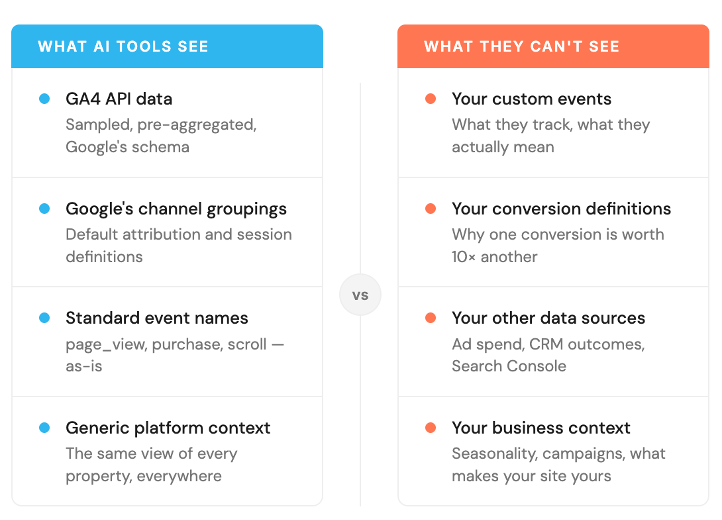
Ask it “which channel drove the most conversions last month?” and it will answer. It won’t know you classify Paid Social differently. It won’t know that one of your key conversion events isn’t tracked as a GA4 conversion. It won’t know that three months of historical data have a channel grouping issue inflating Direct traffic. It just answers, fluently, confidently, and without any of that context.
"With the explosion of AI tools in 2025, the structure of your data model has never been more important, so we have added a section on creating a robust data model to the revised version of this popular blog post. Data quality is critical when you plan to feed that data into an AI model, so you need to put the effort into meticulous planning and documentation of your data so that AI can do some of the other hard work for you."
— Julian Erbsloeh, Head of Data and Insight
Why BigQuery changes the picture
The first thing to consider is who needs to be involved. The complexity and implementation of your measurement framework depend on your organisation's size, as does the number of people involved in the exercise.
With that in mind, ensure that one of the team members has the following skills to create the plan:
Someone who understands your business objectives and strategy
Someone who understands web analytics and what it can do
Someone technical who can set up your custom tracking configuration
A data engineer or data scientist who may work with the raw data outputs of whatever you collect, planning to feed them into LLMs or AI tools of some description
This process means bringing different stakeholders together for large organisations (which can be challenging). Importantly, obtaining buy-in from C-suite executives at this stage provides the project with the attention it deserves and the motivation to complete the exercise.
Why raw BigQuery data isn’t the answer either
Having access to raw BigQuery data doesn’t solve the business context problem. It just moves it somewhere with more detail.
The raw GA4 export is built for completeness, not comprehension. Events arrive in a deeply nested, session-fragmented structure that reflects how GA4 collects data, not how any particular business thinks about its performance. Every property looks identical at the schema level. There’s nothing in the export that tells an AI what matters here, what this event means in this context, or why this conversion is worth ten times more than that one.
Hand that to an AI and it will do what it always does: make reasonable assumptions based on what it’s seen before. It will treat your custom events like standard ones. It will apply generic logic to channel groupings that your team spent months defining differently. It will answer questions about your data using a model of your business it has entirely invented, and it will do so confidently, because it has no way of knowing what it’s missing.
More data isn’t the same as better understanding. Without a layer that translates the raw export into something that reflects how your business actually works, your definitions, your logic, your priorities, you’ve just given the AI a bigger table to misread.
What “AI-ready” data actually looks like
Making GA4 data AI-ready means building a structured transformation layer on top of the raw export. At Fresh Egg, we call ours the mastertable: a session-grain analytics table that runs incrementally every day and does the foundational work that makes AI analysis viable.
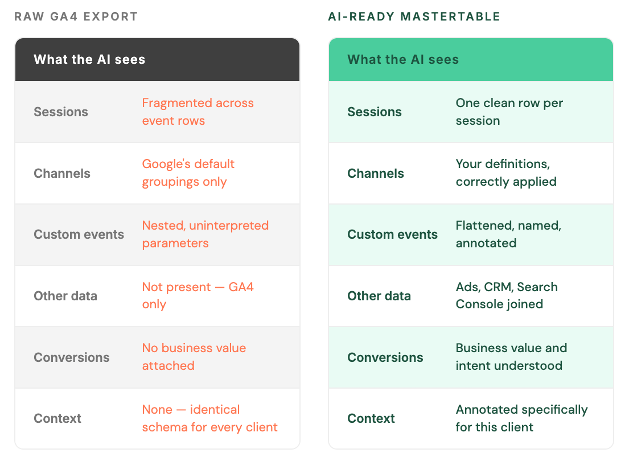
In practice, that means reconstructing sessions from raw events, building a defensive attribution waterfall that handles the edge cases GA4’s API glosses over, normalising channel groupings, folding in custom dimensions and event parameters in a form an AI can actually use, handling consent state correctly, and joining in the data sources that matter. Ad spend, search queries, CRM signals. So the table reflects the full picture, not just what GA4 saw.
It also means documenting and annotating that table so an AI understands it. Not just the schema, but the business context. What this client considers a meaningful conversion. Which columns carry which signals. What the known quirks and limitations are. What questions this data can and can’t answer.
That last part is what most AI analytics tools skip entirely. They connect to the data. They don’t understand it.
The question worth asking first
Before asking “can AI answer questions about our analytics data?”, it’s worth asking a more fundamental one: is your analytics data in a state where it can be trusted to answer questions at all?
For most organisations using GA4, the honest answer is: partially. Headline numbers are probably fine. The detailed, segmented, historically consistent analysis that drives real decisions, the kind an AI would need to be genuinely useful, probably isn’t, yet.
That’s not a criticism of GA4. It’s a reflection of what production-grade analytics infrastructure actually requires. The good news is it’s entirely solvable, and organisations that do this work now will be in a meaningfully better position as AI analytics tooling continues to mature.
We’ll be sharing more about what that looks like in practice, including what we’ve built on top of it, soon.
What Next?
If you need help creating and implementing a data platform that enriches AI, rather than confuses it, we can help. We offer various services related to digital analytics, data engineering, analysis, reporting, and business insights, which we would love to discuss with you.
Get in touch to learn more about how we can help you and your business extract valuable, actionable insight and get a step ahead of your competition.
Get Fresh Thinking and Stay Ahead of Digital Marketing Trends
Subscribe to our Fresh Thinking Newsletter and get...
✅ Exclusive invites to our helpful knowledge-share events ✅ Curated news roundup of pertinent and topical industry news ✅ Early access to our industry resources and insights
Register for Fresh Thinking and keep up to date with our helpful digital marketing news insights.