Guide to User Centred Design
Putting user needs at the heart of every design decision.
 Stephen Carpenter
1.Introduction
Stephen Carpenter shares his perspective on why user-centred design matters, the challenges facing modern digital experiences, and how organisations can create greater value by understanding and designing for their users first.
Beyond assumptions
Many organisations claim to be doing UX but really, they’re incorrectly applying the term to their often outdated design process. I am going to lay it on the line here - you can’t do UX without understanding your users.
This is an idea that has been perfectly expressed by Hoa Loranger, VP a Nielsen Norman Group, in her article, UX without user research is not UX.
Just so we are clear, the founders of Nielsen Norman Group, Don Norman and Jakob Nielsen, pretty much invented UX. When they started the company in 1998, they defined it as follows:
The first requirement for an exemplary user experience is to meet the exact needs of the customer, without fuss or bother. Next comes simplicity and elegance that produce products that are a joy to own, a joy to use.
I think about Dom and Jakob and the efforts they’ve made to change the world of design whenever I see digital experiences that have clearly been designed without any regard for the user. I imagine Dom and Jakob looking a bit deflated, though never angry. This is even more upsetting if you know what Dom looks like. An old colleague of mine nicknamed Dom ‘Papa UX’.
Google him and you’ll understand.
Too often, experiences are designed with a focus on business goals, fancy features, and the technological capabilities of new platforms and software. But user centred design (UCD) is a methodology that puts user needs at the centre of a product or solution. It aims to give users a voice at the boardroom table and helps businesses offer a point of distinction over their competitors while addressing the core needs of their customers.
Please don’t think that UCD means ignoring your organisation’s focus or objectives. It simply lets users’ needs drive a solution that delivers value to a business.
There’s a perception that UCD is an expensive approach to design, but this doesn’t have to be the case. The process can work for a variety of budgets and scales. The most crucial part is a shift in mindset, to a place where you don’t take the voice of the loudest stakeholder as gospel but you get out there, speak to customers and discover the truth. I know this can be a daunting idea, but take those stakeholders on the journey with you and it won’t be long before they see the value of a user centred design approach.
2.What is user centred design?
Discover the principles of user-centred design and why putting users first leads to better products, services and business outcomes.
User centred design at Fresh Egg
We believe user centred design broadly breaks down into three essential ingredients.
Understand your audience
Identify the people who will use the product or solution, what they will use it for, and the circumstances in which they will use it.
Consider:
Their needs
Their goals
Their behaviours
Their influences
Their feelings
Their pain points
Let everyone have a voice
Define the business and technical requirements that must be met for a solution to succeed. Great user centred design happens where business needs, technical requirements, and user needs meet.
Create solutions iteratively
Develop ideas progressively, from rough concepts through to fully realised designs.
Throughout the process, continually test and evaluate solutions with real users to ensure they meet genuine needs.

3.Key advantages of UCD
Explore the benefits of a user-centred approach, from clearer requirements and stronger customer loyalty to better business results.
The benefits of putting users first
Clearer requirements
Traditional requirements are often driven primarily by business needs. When user needs shape the solution, requirements become more accurate, relevant, and actionable from the outset.
Increased value per user
People are more likely to choose products and services that provide a superior user experience. When two brands offer similar products and pricing, user experience can often become the deciding factor.
Reduced waste
Research and testing reduce the risk of failure by validating assumptions before significant resources are invested.
Benefits include:
Better usability
Improved conversion rates
Reduced project risk
More efficient use of resources
Added value across the business
Research findings often provide value beyond the original project.
Insights gained through user research can inform strategy, customer service, marketing, product development, and wider organisational decision-making.
Extended solution life
Products designed around user needs are more likely to remain relevant over time. However, user needs evolve, making continuous learning and iteration essential.
4.How your business can embrace UCD
Learn the practical methods, research techniques and collaborative activities that bring user-centred design into your organisation.
Take a voyage of discovery
Without understanding your users, their needs, and their behaviours, any solution is likely to fall short of expectations.
The discovery phase focuses on uncovering facts and insights that inform design decisions.
Kick-off workshop
Bring stakeholders together to:
Define project goals
Establish product vision
Align expectations
Identify target audiences
Capture existing knowledge
This creates a shared understanding before design work begins.
Stakeholder interviews
Conduct one-to-one interviews with stakeholders to understand:
Individual goals
Success measures
Project expectations
Existing assumptions
Remember that stakeholders extend beyond senior decision-makers. Customer service teams, sales teams, and frontline staff often provide valuable customer insight.
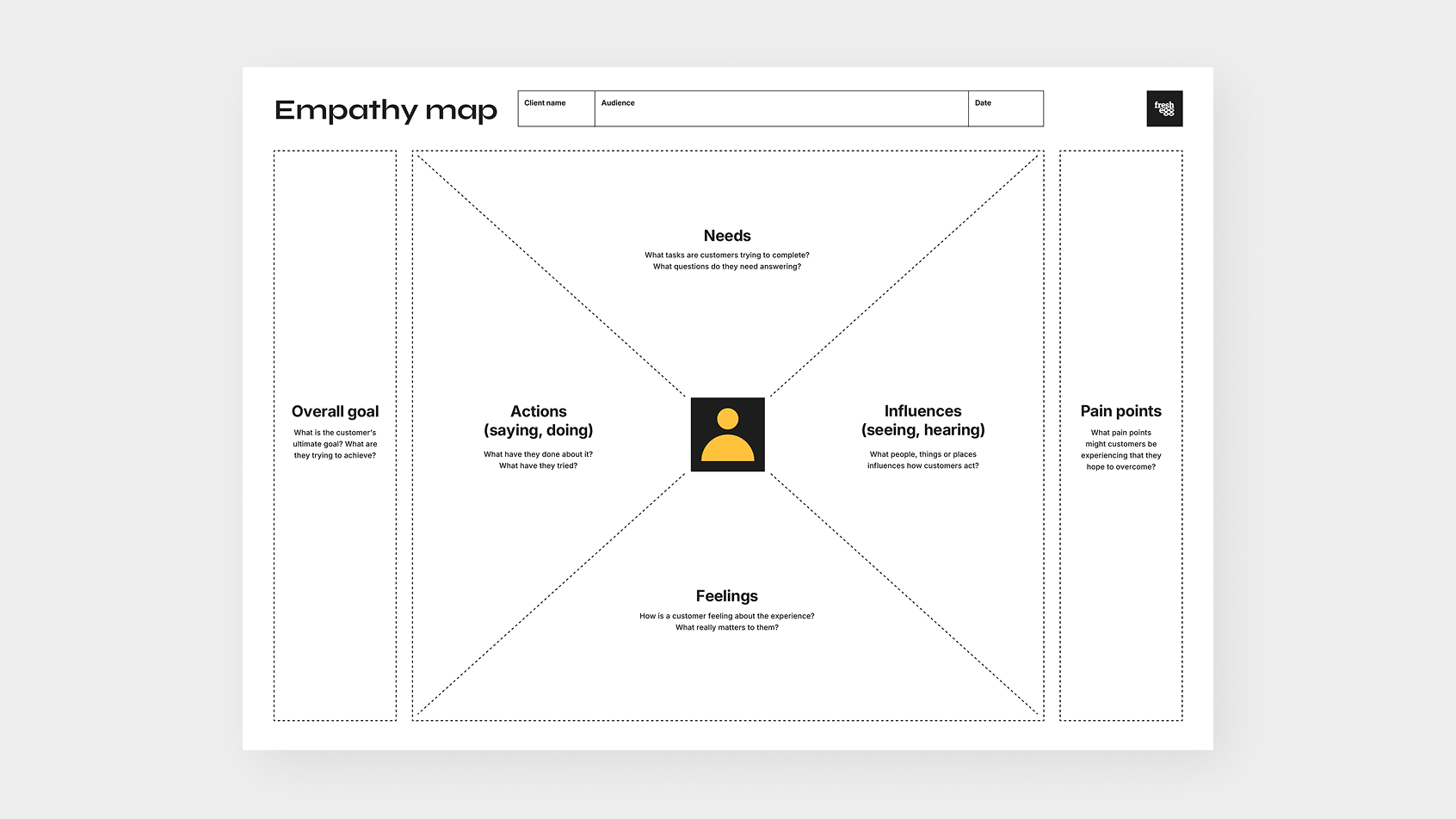
Empathy mapping
Empathy mapping helps stakeholders think from the customer's perspective rather than the organisation's perspective.
It encourages teams to consider:
What customers think
What customers feel
What customers see
What customers do
What influences their decisions
What goals they are trying to achieve
Empathy maps can then be used as hypotheses to validate through research.
Data insight
Where an existing solution already exists, analysing data provides a valuable starting point. Data can show what is happening, such as where users are dropping off or how they are interacting with a product or service. However, research is needed to understand why those behaviours are happening. By combining quantitative data with qualitative research, you can build a more complete picture of user behaviour and make better-informed design decisions.
User interviews and testing
User interviews validate or challenge stakeholder assumptions and empathy maps.
Research should involve:
Existing users
Potential users
New audiences
User interviews
Conversations that explore:
Behaviours
Motivations
Challenges
Needs
User testing
Observing users as they interact with a product or service to identify:
Friction points
Usability issues
Areas for improvement
Types of user testing
Remote moderated testing
Users undertake tasks with no supervision, in their own time from their own homes. This is often the cheapest option and can be completed through tools like usertesting.com.
In-person moderated testing
Users travel to a testing ‘lab’ to undertake a series of tasks given to them by a moderator. User testing can be a hard to secure budget for, but it is the most important part of the process. It will provide insights that can set you apart from the competition and allow you to create digital experiences to be proud of.
Remote unmoderated testing
Users complete tasks independently using online testing platforms. While user testing can sometimes be difficult to secure budget for, it remains one of the most valuable parts of the entire process.
Collaborate, experiment and validate
Bring together stakeholders, designers, and developers to create and test ideas early.
A typical process might look like:
Discovery workshop
Prototype creation
User testing
Feedback gathering
Optimisation
Ongoing enhancement
This approach helps teams validate ideas before committing significant time and resources.
Good design is actually a lot harder to notice than poor design, in part because good design fits our needs so well that the design is invisible.
5.How to move towards UCD excellence
Understand the stages of design maturity and how to create experiences that progress from functional to meaningful.
The Experience Success Ladder
Developed by Ward Andrews of Drawbackwards, the Experience Success Ladder provides a framework for evaluating design maturity and user satisfaction.
Each stage represents a deeper level of value creation.
Functional Level
Functional experiences allow users to complete tasks.
However, they often:
Feel confusing
Create frustration
Fail to meet real user needs
Are driven primarily by internal preferences
Common consequences include user abandonment and wasted investment.
Usable Level
Usable experiences improve upon functionality by applying recognised design principles.
However, they may still:
Be based on assumptions
Cause friction
Lack genuine user insight
Users can complete tasks, but the experience may still be frustrating.
Comfortable Level
Comfortable experiences feel intuitive and familiar.
Benefits include:
Higher satisfaction
Increased revenue
Greater customer loyalty
Reduced effort for users
Stronger market position
These experiences often emerge when organisations genuinely embrace user centred design.
Delightful Level
Delightful experiences move beyond usability and create emotional engagement.
Examples include:
Thoughtful interactions
Useful surprises
Memorable moments
Rewarding experiences
Benefits include:
Increased positive feedback
Improved KPIs
Stronger brand advocacy
More engaged customers
Meaningful Level
Meaningful experiences create lasting value for users and businesses alike.
They:
Change users' lives
Build deep loyalty
Generate advocacy
Strengthen long-term business success
The most successful organisations consistently focus on user needs as their guiding principle.
6.Next steps
Bring everything together with actionable guidance for embedding user-centred design into your products, services and culture.
Putting it all together
Placing your users at the heart of your product design and development is of benefit both to them and to your business.
By understanding your audience, you can create experiences that are:
Useful
Intuitive
Enjoyable
Valuable
Success begins with discovery and continues through research, testing, iteration, and ongoing improvement. When done well, user centred design can create meaningful experiences that turn customers into advocates.
Benefits include:
Clearer requirements
Increased customer value
Better brand loyalty
Higher sales
Reduced waste
Longer-lasting solutions
User centred design is accessible to organisations of all sizes and budgets.
Useful resources