GEO experiments: how awards get you recommended in AI search
- Published
- 20 November 2026
- Read time
- 6 mins
Your brand won an award. You feel it’s driving sales, but you can’t prove it. We used AI prompt tracking to see what one award was actually doing for an insurance client, tested the pattern across 10 industries, and built a simple two-step way to put a £ value on it.
 Tom Light
Every year, brands spend time and money entering awards, paying for logo licences and promoting their wins. And every year, someone in the finance team asks the same question: is it worth it?
Usually, the honest answer is “we think so”. Awards feel like they build trust, but it’s hard to trace a sale back to a badge on a website.
AI search changes that. When someone asks ChatGPT or Google “what’s the best home insurance?”, the answer is built from sources you can see and track. So for the first time, you can measure whether your award is being used, whether it’s helping you get recommended, and roughly what that’s worth.
By the end of this article, you should know how AI uses awards, how much difference they can make, and how to calculate the value of your own.
The client who couldn’t prove it
One of our insurance clients had won a well-known consumer award. Their team felt it was driving conversions, but they had no way to show it.
We tracked 37 “best” questions in their category, such as “what’s the best insurance for…”, across ChatGPT, Gemini and Google’s AI Overviews. That gave us 2,467 AI answers to work with.
Two things stood out. First, ChatGPT used the award body as a source in 95% of its answers to those questions. Second, when the award body was in the answer, our client was far more likely to be recommended first.
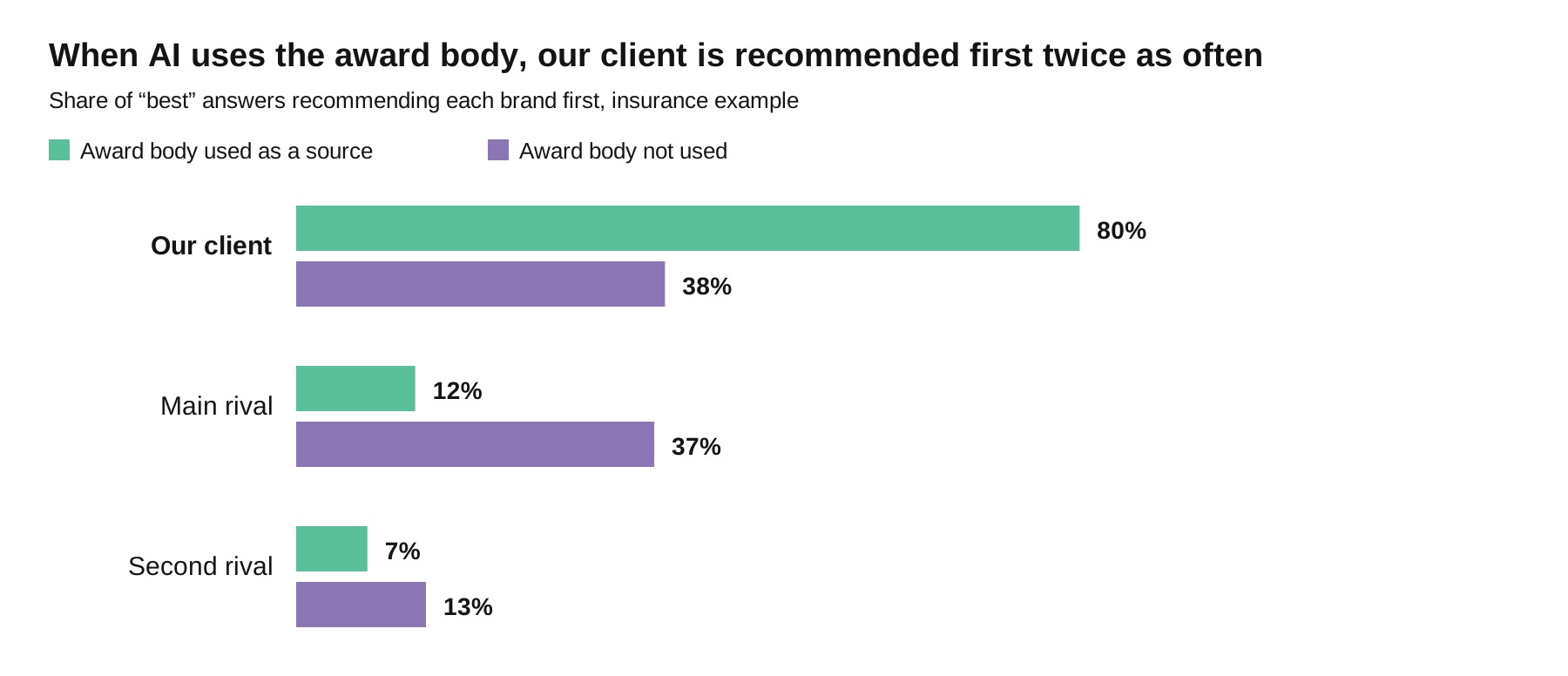
When the award body was used as a source, our client was recommended first in 80% of answers. When it wasn’t, our client and its main rival were neck and neck, at 38% and 37%. The award was what set them apart.
How AI decides who’s “best”
Was this a one-off? To find out, we ran 50 “best” questions across 10 other UK industries, from energy and broadband to cruises and estate agents, every day for five days. That gave us 1,200 AI answers to analyse.
The pattern was clear:
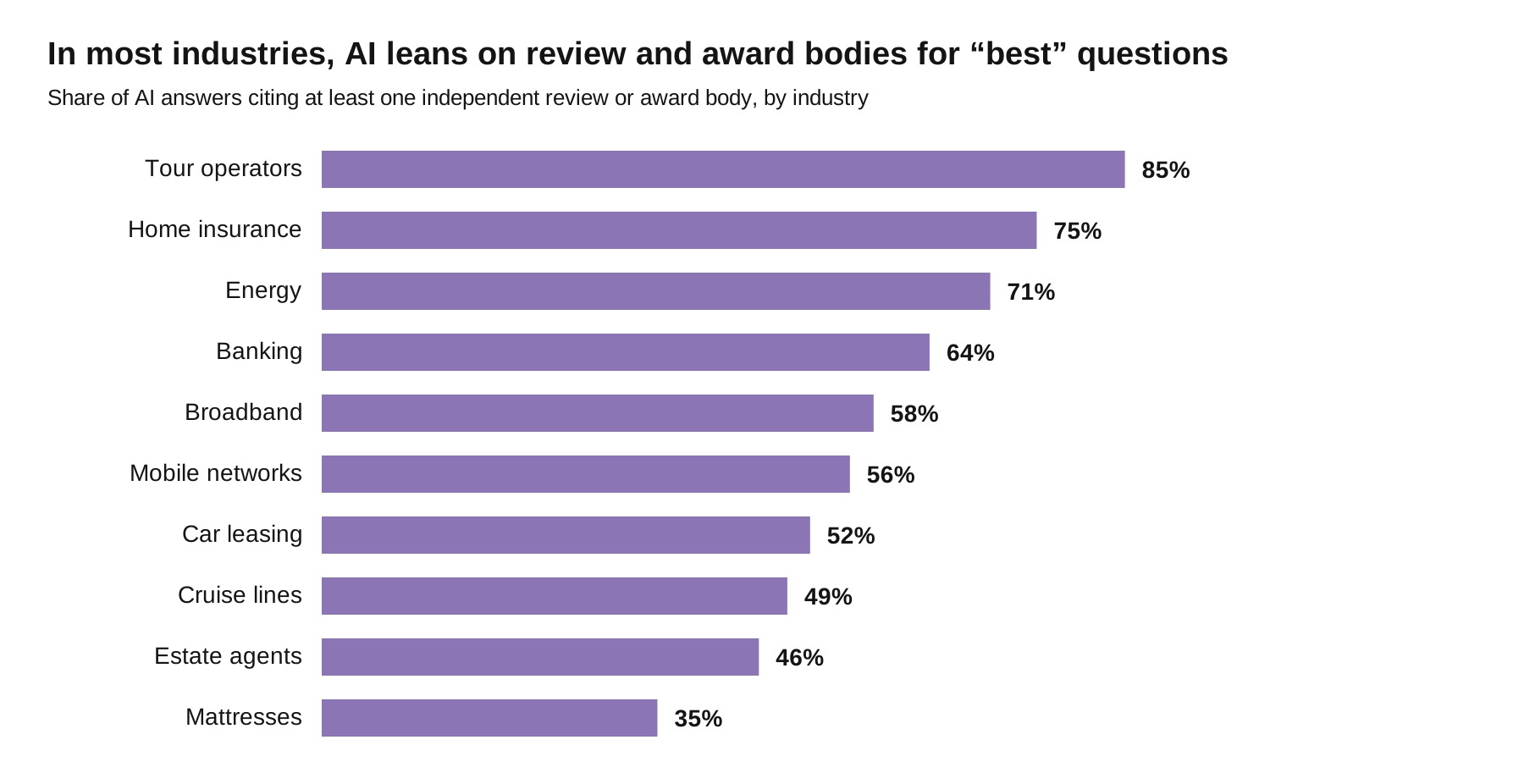
AI almost always leans on someone else’s judgement. 92% of answers with sources drew on third parties, such as review bodies, comparison sites, publishers or forums.
Review and award bodies are a big part of that. 59% of answers cited at least one independent review or award body. Which? alone appeared in nearly half.
AI repeats the award, not just reads it. In 68% of answers, the text itself named an award, rating or customer survey as the reason for a recommendation, with phrases like “consistently scores highly in customer satisfaction surveys”.
This fits wider research. An Ahrefs study of 75,000 brands found brand mentions on other websites predict AI visibility three times better than backlinks. And AirOps found that nearly 90% of third-party brand mentions in AI answers come from reviews, comparisons and “best of” lists. An award is exactly that kind of third-party proof.
Putting a £ value on an award
Here’s the part finance teams care about. You don’t need a complicated model. You need two things most brands investing in AI search already have: prompt tracking and the AI revenue figure in GA4.
Step 1: How much more likely are you to be recommended?
From your prompt tracking, take three numbers: how often AI uses your award body as a source, how often you’re recommended first when it does, and how often you’re recommended first when it doesn’t.
As an example, take a source rate of 60%, close to the average across our 10 industries, plus our client’s figures of 80% with the award body and 38% without. When AI used the award body, they were 2.1 times more likely to be recommended first.
Those three numbers tell you what share of your AI recommendations are down to the award:
Award share = (source rate × (with − without)) ÷ (source rate × with + (1 − source rate) × without)
Without the award, the brand would be recommended first in 38% of answers. With it, the figure is 63% overall. That means around 40% of its first recommendations come from the award.
Step 2: Apply it to the AI revenue you already track
Award value = annual revenue from AI tools (GA4) × award share
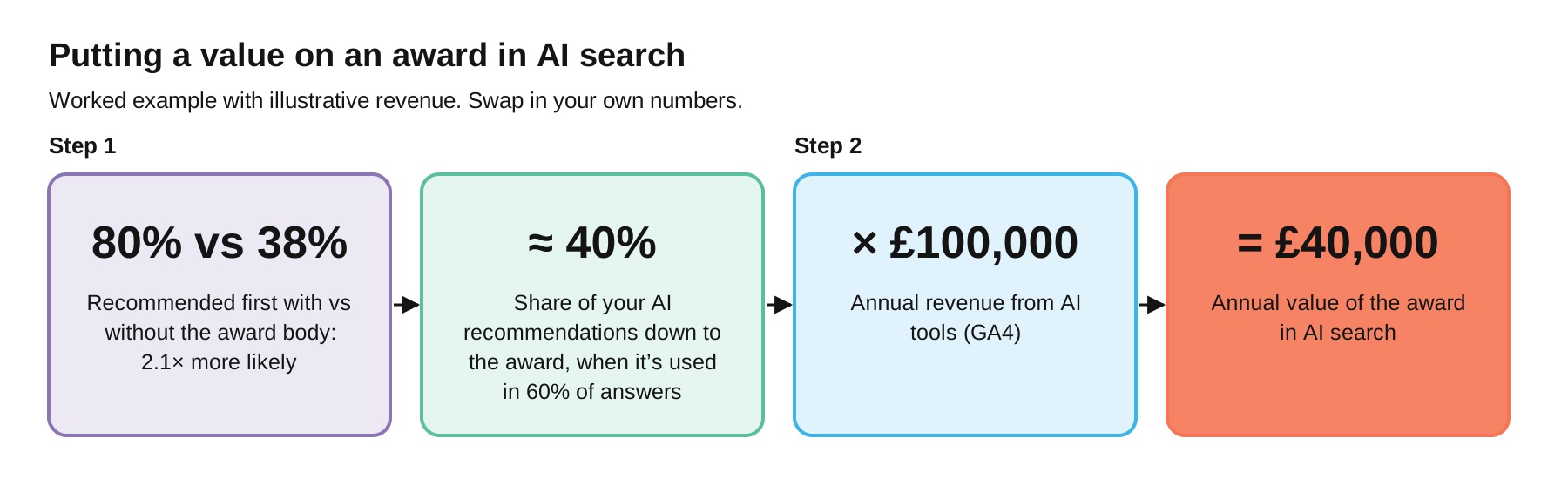
If GA4 shows £100,000 a year in revenue from AI tools, around £40,000 of it can be attributed to the award. Compare that with what the award costs you, including entry fees, logo licences and time, and you have your return.
Awards mostly influence “best” and comparison questions. If you know what share of your AI revenue comes from those kinds of questions, apply it to make the figure more cautious.
This is deliberately conservative. It only values revenue that arrives directly from AI tools. People who see an AI recommendation and then search for you on Google, or come straight to your site, aren’t counted, so the true value is likely to be higher.
No prompt tracking yet? Use our industry averages for the source rate and our client’s figures as a starting point, then replace them with your own data as you collect it.
Awards have always been hard to justify on a spreadsheet. AI search gives us a way to see what they’re actually doing. If AI is using your award as the reason to recommend you, that’s not a nice-to-have badge any more. It’s a measurable part of how customers find you.
Not all awards are equal
Two findings matter when deciding which awards to go after.
The right award depends on your sector. In energy, home insurance and package holidays, AI leaned heavily on one major consumer body, which appeared in 68% to 79% of answers. But for car leasing, cruises and estate agents, that body appeared in fewer than one in five answers. AI turned to specialist sources instead, such as industry review sites and sector-specific ratings. The biggest name isn’t always the one AI trusts in your market.
The platform matters too.
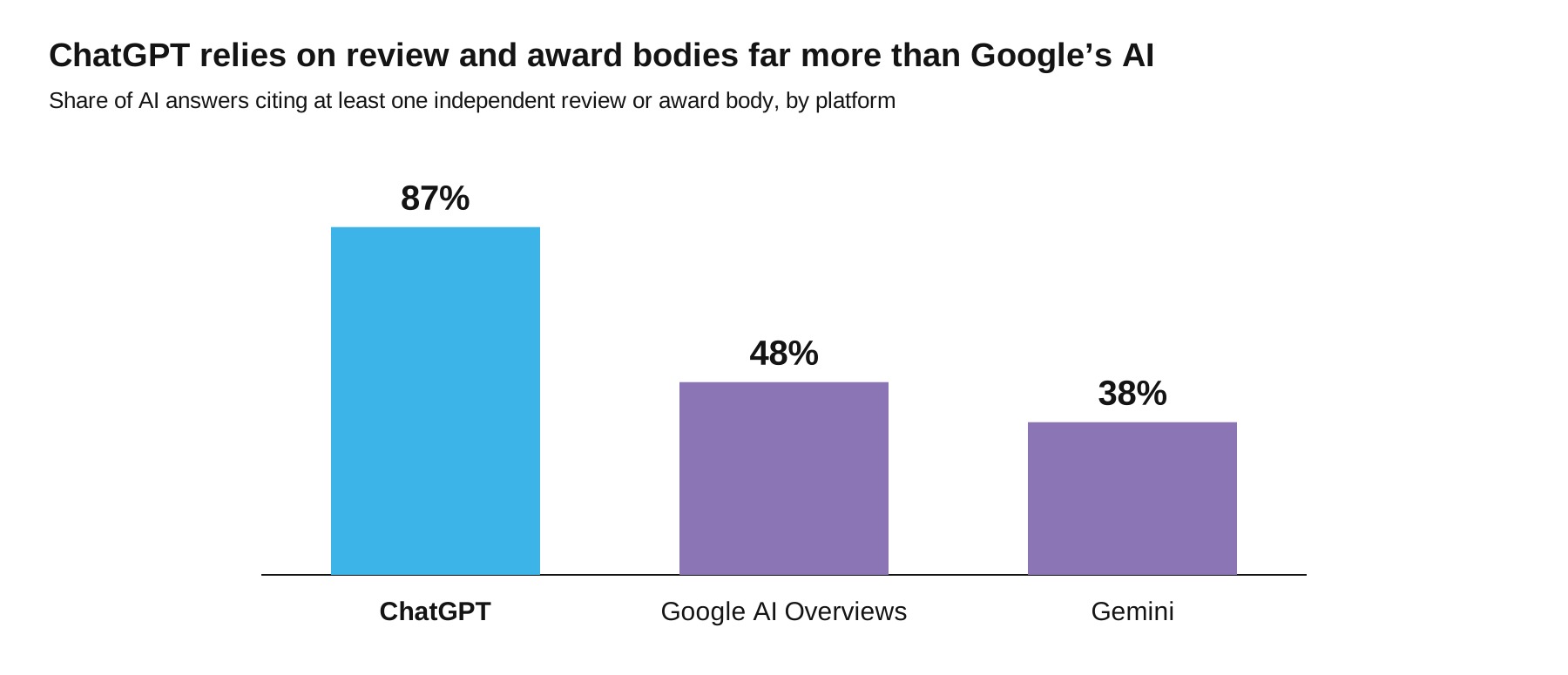
ChatGPT cited review or award bodies in 87% of answers, far more than Google’s AI Overviews and Gemini. Since ChatGPT sends most AI referral traffic for most brands, that’s where awards are likely to have the biggest effect. We explain more about the differences in why you need to track more than one AI model.
How to make your award work harder
Winning the award is only the start. To get the most from it in AI search:
Check AI is using it
Ask the “best” questions your customers ask, in ChatGPT, Gemini and Google, and see whether your award body appears as a source.
Make it easy to find on your site
Explain the award clearly on a dedicated page, not just as a logo in the footer, and add it to your structured data.
Get it talked about
Press coverage and mentions on other sites help AI connect your brand with the award. That’s why digital PR matters more than ever in the age of AI search.
Get onto the “best of” pages AI reads
In our study, list articles and comparison pages made up nearly half of all the pages AI used.
Track it over time
If the award lapses, or a competitor wins it next year, you’ll see the effect.
A note on what this does and doesn’t prove
This shows a strong link between an award and being recommended first, not proof that the award causes it. Brands that win awards may also have better products, more reviews and stronger reputations. Our 10-industry study covers five days of tracking in November 2026, and we’ll update it as more data comes in.
That’s why the calculation is best used as an estimate rather than a precise figure. It gives you a reasonable, evidence-based figure to discuss, which is a lot better than “we think so”.
What next
Awards have always been about trust. In AI search, that trust becomes visible and measurable. If AI is using your award to decide who to recommend, it’s worth knowing, and worth putting a number on.
If you’d like help tracking what your awards are worth in AI search, talk to us. For more experiments like this one, read GEO experiments: how content gap analysis got our clients cited in AI search and what missing price information costs you in AI search.
Find out what your awards are worth in AI search
Our GEO services show how AI platforms see your brand, which sources they trust, and where third-party proof like awards can win you recommendations.