AI search is already here, is your website ready?
- Published
- 10 December 2025
- Read time
- 10 min read
AI search is here. Learn how GEO, AI Overviews and LLM tools like ChatGPT reshape visibility, and the steps to make your website citation-ready with Fresh Egg.
 Tom Light
In 2026, AI search is no longer a future trend or an experiment happening in tech labs. It's here. It's visible in your web traffic. It's reshaping how users discover, evaluate, and engage with brands. And if you're still approaching SEO, content and optimisation through a pre-AI lens, you're long behind. The shift is no longer coming; the revolution has begun.
2.The shifting sands
According to recent data, over 55% of Google searches now trigger an AI Overview (AIO). Tools like ChatGPT, Perplexity, and Claude serve millions of prompts daily, often replacing traditional search entirely. And yet, most websites are not optimised to appear in these environments. They're effectively invisible.
So, is your website ready to be found, trusted, and chosen in the age of AI search?
AI search isn't a 'nice-to-have' channel anymore
It's already influencing your traffic and your pipeline. The brands winning in 2026 will be the ones that make their content prompt-ready, citation-worthy, and demonstrably useful, so they show up in AI Overviews and LLM answers as the trusted source. If you're not being referenced there, you're not just losing rankings, you're losing consideration, and ultimately business.
3.The AI search revolution in numbers
Let's start with context:
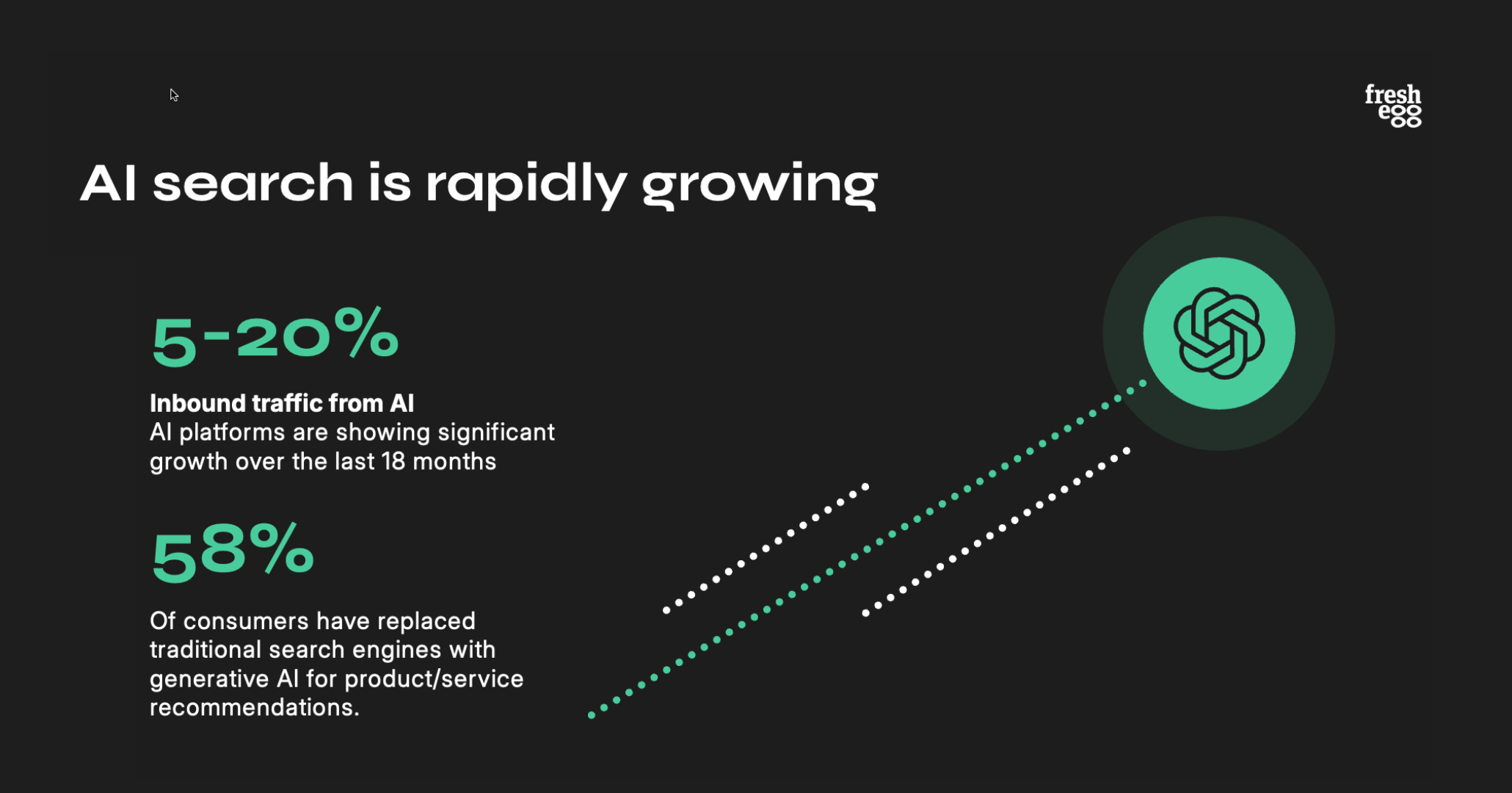
378+ million people use AI tools globally (2025 projection)
58% of users say they use generative AI tools instead of Google for product or service research
49% of users still click blue links after reading AI-generated answers – but your chance to earn that click is slimmer than ever
This change is not just a tweak to traditional search. It's a fundamental shift in how users interact with information.
4.What AI search actually means
There are two key ecosystems at play:
1. AI Overviews (AIOs):
Appear within traditional search engines like Google
Summarise content from indexed web pages
Link to sources, but only cite a handful
2. LLM-based Tools (ChatGPT, Perplexity, Claude, Gemini, etc.):
Independent of search engines
Provide conversational, multi-step answers
Reference a mix of open web content, forums, and proprietary data
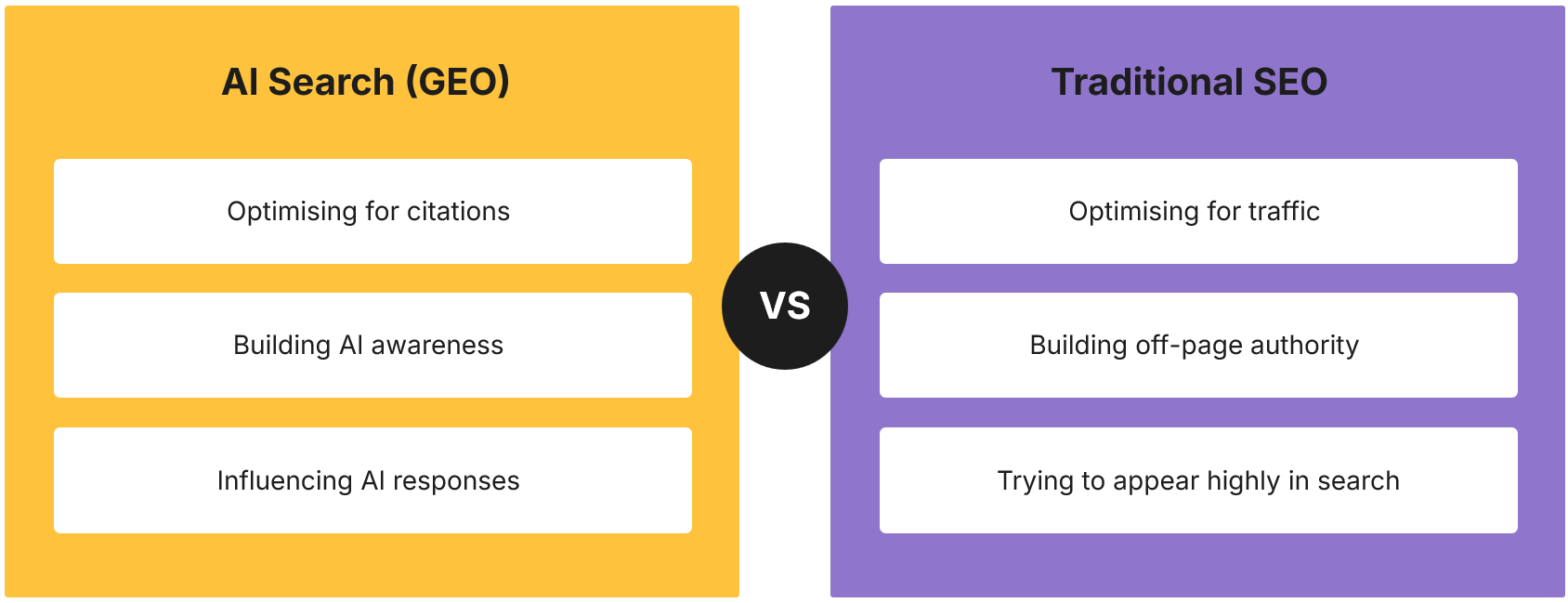
AI search is not about "ranking", it's about being cited, quoted, referenced, or summarised. If you're not showing up in the answers, you're not even in the conversation.
5.How to know if you're AI search ready
Use this quick checklist to assess AI search (GEO) readiness:
Is your content designed to answer prompts rather than just match keywords?
Do you monitor visibility in AI tools like Perplexity or ChatGPT?
Do you structure your content for clarity, accuracy, and citation?
Are you being mentioned in third-party sources like Reddit, Wikipedia, or authoritative media?
Have you tested how your brand appears in AI assistants?
If the answer is "no" to most of these, you're in Stage 1 or 2 of the AI Search Maturity Model: Awareness or Exploration. That's not a bad thing, but it means now is the time to act.
6.The risk, visibility you can't track
One of the biggest challenges brands face is measuring their visibility in AI environments. Unlike traditional SEO, where you can track keyword rankings and impressions, AI citations are:
Harder to spot
Not always clicked
Often surfaced without attribution
Your brand may already appear in ChatGPT responses without your knowledge. Or worse, your competitors might be dominating AI responses while you fade into obscurity.
7.Tradtional search vs AI search, what's the difference?
8.Immediate steps you can take
Test prompts yourself
Search in ChatGPT or Perplexity for prompts like:
"Best [product/service] for [audience]"
"What does [your brand] do?"
"[Problem] + solution suggestions"
See if you appear. If not, ask why not.
Audit your content
Does it answer high-context questions?
Is it structured clearly (with FAQs, summaries, and schema)?
Is it quotable and fact-based?
Build brand signals off-site
Track what you can
Use tools like Accuranker, SEMrush, and Ahrefs for early signals of AI Overviews
Review Google Analytics and Google Search Console for traffic drops tied to known AI-related queries
9.A quick look ahead
In the next 6–12 months, we expect:
Greater AI integration within search (Gemini, SGE rollouts)
More SEO tools to provide AI citation data
New standards for prompt optimisation and AI tracking
Brands that move first will gain authority faster.
10.Our perspective
AI search is not a trend; it's a structural shift in digital experience. Our integrated approach across SEO, content, CRO and analytics means we're uniquely placed to:
Track AI visibility
Create prompt-ready content
Optimise for authority and citation
Align search strategy with intelligent digital experiences
Need help assessing your AI performance?
If you want your website to be ready for where users are going next, let's talk. We'll run an AI Search Readiness Audit. We'll show you where you stand, and what to do next.