Ask Google Ads to get you more leads and it will. Whether those leads are any good is another matter.
Ad platforms learn from the conversions you report back to them. Tell them a form fill is a win and they'll go and find people who fill in forms, including the ones who never pick up the phone, the student researching an assignment and the competitor checking your prices. From the platform's side, a form that turns into a five-figure policy looks identical to one that goes nowhere, so it chases volume.
Signal engineering, sometimes called ad platform signal optimization or conversion signal optimisation, is how you change what the platform is chasing. You give it better information about which conversions actually made you money, and it starts looking for more of those people instead.
What is signal engineering?
Signal engineering is the work of deciding what an ad platform should learn from, then turning your own business data into conversion signals it can understand and act on. In other words, ad platform signal optimisation: improving the signals you send so that bidding favours value over volume.
If you've searched the term before, you'll know it's a bit overloaded. Most results are about electronics and railway signalling. In digital marketing it refers to the conversion data that Google Ads, Meta and Microsoft Ads use to decide who sees your ads and how much to bid.
A signal is the conversion event plus whatever detail travels with it. When we engineer one, we're usually working on three questions. Which events deserve to count, and what are they worth? A quote for a fleet policy and a quote for a moped shouldn't carry the same value. How many real conversions are making it through, and can the platform match them to the click that started them? And does the signal arrive in time? Platforms learn inside an attribution window, so if the sale closes six weeks after the enquiry, you need to send something earlier that predicts it.
This is where it differs from tracking. Good tracking records what happened, whereas signal engineering decides what the algorithm should go after, which is why it tends to sit with analysts and data engineers rather than whoever set up the tags.
Why it's become hard to ignore
Automation has made signals one of the few levers left in your hands. Performance Max, Advantage+ and smart bidding now handle targeting, bids and placements. You set a budget and a goal; the platform works out the rest from the conversion data you feed it.
Plenty of time goes into budget allocation and creative, and rightly so. Far less goes into the signals, even though every bid the algorithm places is based on them.
Meanwhile, the data reaching the platforms keeps getting patchier. Ad blockers and Apple's Intelligent Tracking Prevention either block conversions outright or shorten cookie lifetimes until a conversion can't be tied back to its click. On the sites we audit, that typically accounts for around 20% of traffic and conversions. Consent choices remove another slice, which the platforms fill with modelled data. And anything that happens offline, such as a policy sold over the phone or an application approved a fortnight later, never reaches the platform unless someone sends it.
Put those together and you have an algorithm spending real money on partial information. For a lot of the marketing teams we speak to, it shows up as media costs creeping up while conversion rates stay flat.
How signal engineering works
Signal engineering sets up a loop between your ads and what happens in the business afterwards. Every pass round the loop gives the platform a clearer idea of who your valuable customers are.
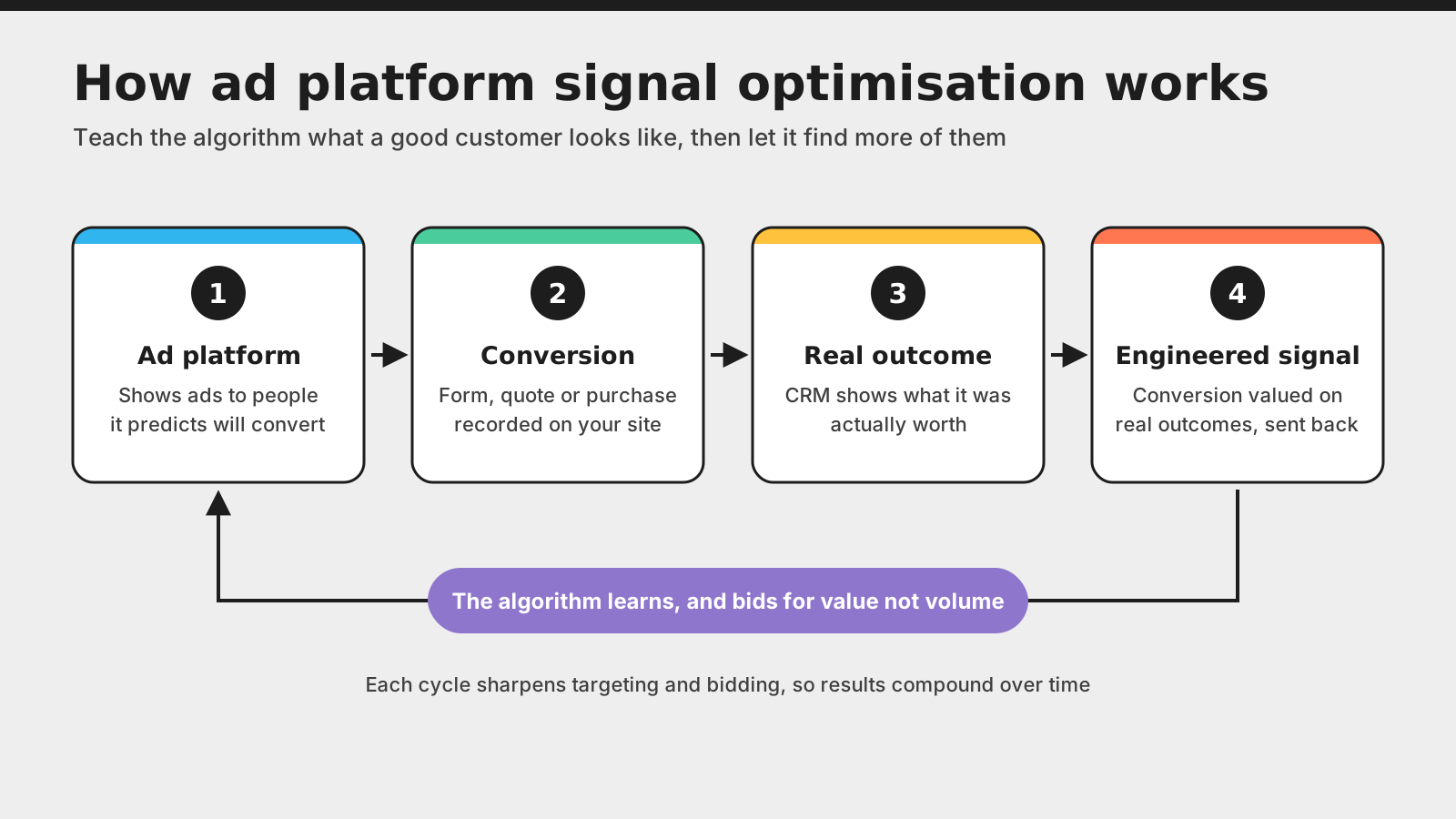
It starts with the ad platform showing your ads to whoever it currently thinks is most likely to convert. Someone clicks, then fills in a form, starts a quote or buys something. Most advertisers stop the story there.
The useful part comes next. A few days or weeks later, your CRM, sales system or order data knows what that conversion was really worth: a policy, a confirmed enrolment, a healthy-margin order, or nothing at all. We take that outcome (or a prediction of it), turn it into a value, and send it back to the platform with the identifiers it needs to match it to the original click.
The platform adjusts. It bids harder for people who resemble your best customers and backs off the ones who resemble timewasters. Because each round of data trains the next, the improvement builds over time rather than arriving as a one-off bump.
Server-side tracking: the best foundation for signal engineering
If you're starting from scratch, this is where we'd begin. Signal engineering can work without it (more on that below), but server-side tracking gives you far more to work with.
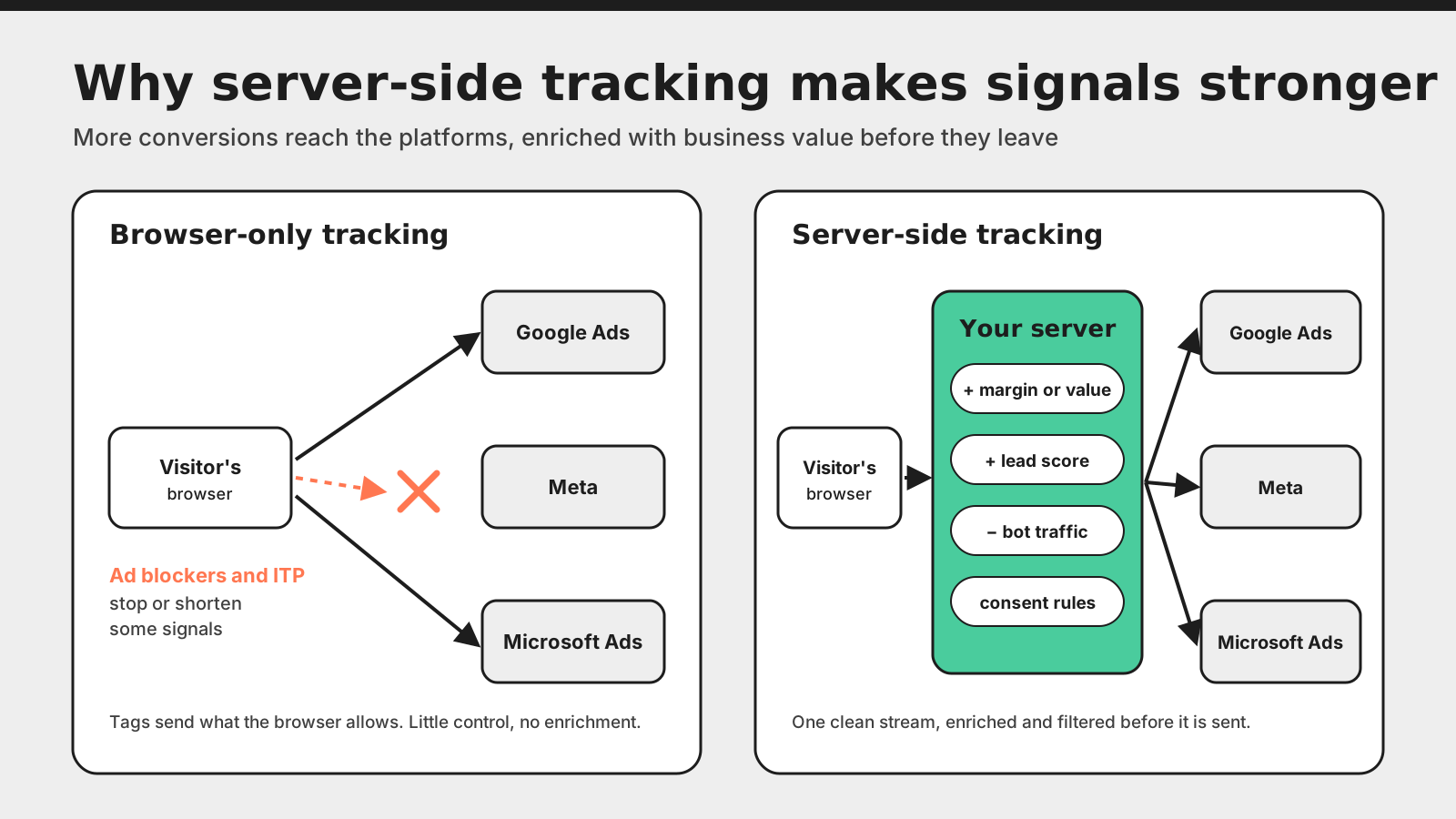
With standard tracking, each platform's tag runs in the visitor's browser and sends data straight to Google, Meta or Microsoft. You don't get much say in what's sent, an ad blocker can stop it completely, and browser restrictions cut short the cookies that link a conversion to a click.
Server-side tracking, usually server-side Google Tag Manager, puts a server you control in the middle. The browser sends one stream of data to that server, which passes it on to each platform through their official routes, such as Google's enhanced conversions and Meta's Conversions API. We use Stape to host and manage these server-side configurations for our clients, so the infrastructure behind the signals is reliable and easy to keep on top of.
That middle step matters for several reasons. You recover a good share of the conversions that ad blockers and tracking prevention would otherwise lose, and first-party cookies last longer, so more conversions get matched to the right click. You can enrich each signal before it leaves, looking up the margin on a basket, attaching a lead score or flagging a returning customer, all in real time while the platform can still use it. You decide exactly which fields each platform receives and strip out anything that shouldn't leave your environment, which makes consent much easier to respect. And with fewer tags running in the browser, the site gets lighter and bot traffic can be filtered out before it pollutes your conversion data.
Plenty of tools will set up server-side tracking for you. We mostly do it because of what it unlocks: richer signals, sent in real time, that teach the algorithm what a good customer looks like.
No server-side tracking? Signal engineering still works
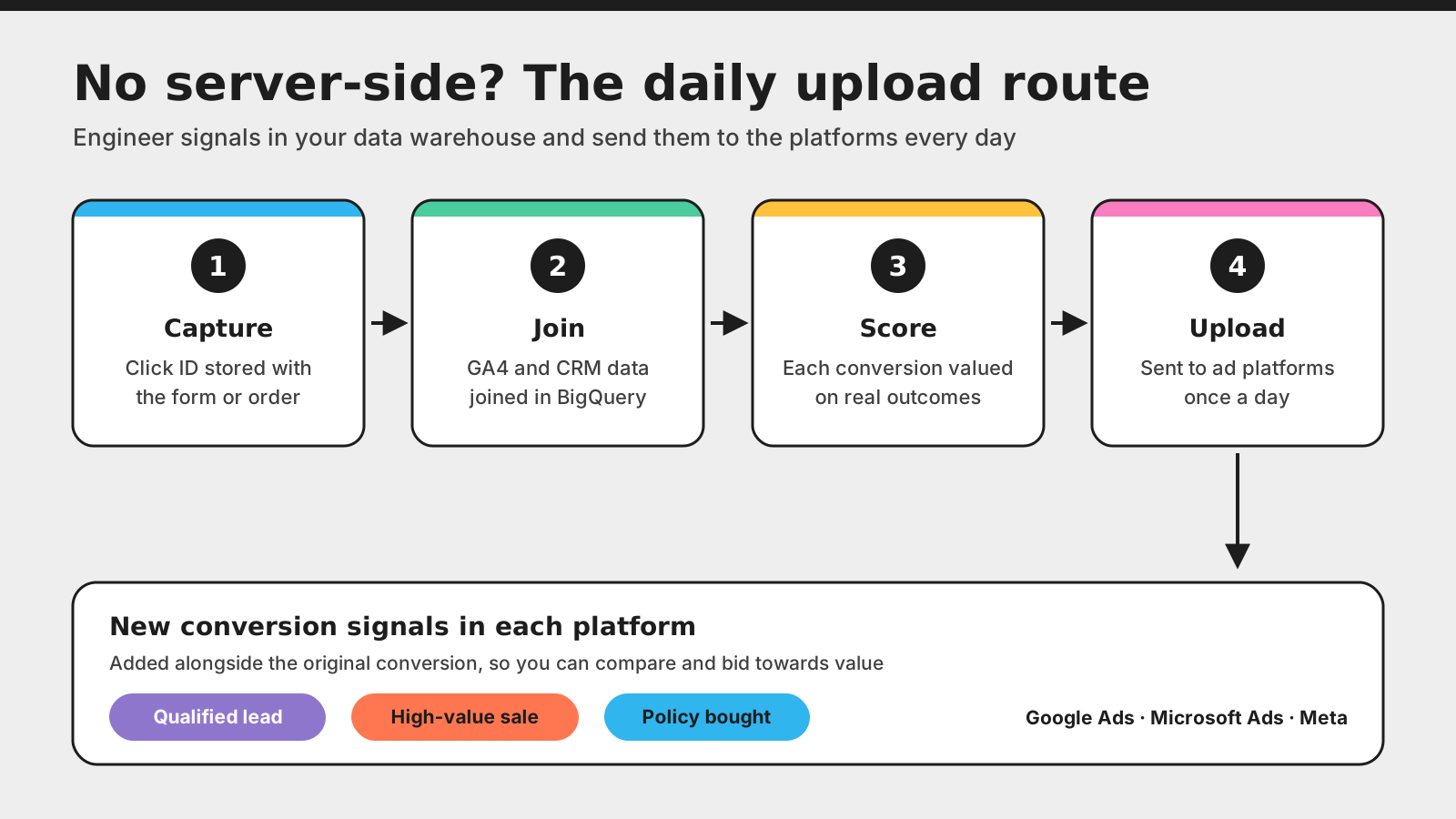
Server-side is the ideal, not a requirement. We've run signal engineering for clients without it by building the engineered signals in their data warehouse and uploading them to the ad platforms once a day.
The first job is capturing the link between the click and the customer. When someone submits a form or places an order, we store an identifier with the record, such as the Google click ID or the GA4 client ID, normally via hidden form fields that pass into the CRM. It's a small change on the site, but it needs thinking through properly, because a CRM migration or a change to consent settings can quietly break it.
From there, GA4 data exported to BigQuery is joined with the CRM or sales data, so every conversion sits next to what actually happened afterwards. We score or value each conversion on real outcomes (a lead quality score, an expected policy value, the margin on an order), and those engineered conversions go to Google Ads, Microsoft Ads and Meta every day through their offline conversion imports.
We don't overwrite the original conversion. Instead, we create additional conversion actions from the engineered data, things like "qualified lead" or "high-value sale". The platforms can bid towards them, and you can compare their performance with the original signal side by side.
There are compromises. Signals land up to a day late, so the algorithm learns more slowly than it would in real time. You still lose some conversions to ad blockers at the point of capture, and match rates are only as good as the click IDs you've stored.
We still think it's well worth doing. It beats sending raw form fills by a distance, it's a low-risk way to prove the value of signal engineering before committing to a server-side migration, and none of the work is wasted if you do migrate later, because the scoring logic moves across as it is.
Contact our Data and Insight team
Our market-leading Data and Insight team offer an extensive range of services to keep you at the top of your game.
There are compromises. Signals land up to a day late, so the algorithm learns more slowly than it would in real time. You still lose some conversions to ad blockers at the point of capture, and match rates are only as good as the click IDs you've stored.
We still think it's well worth doing. It beats sending raw form fills by a distance, it's a low-risk way to prove the value of signal engineering before committing to a server-side migration, and none of the work is wasted if you do migrate later, because the scoring logic moves across as it is.
Signal engineering examples by sector
A good signal is tied to something the business genuinely cares about, turns up while the platform can still learn from it, and can be matched to the ad that produced it. What that means in practice varies a lot from one sector to the next.
Sector | Typical default signal | An optimised signal |
Insurance | Quote started or quote completed | Quote value weighted by the likelihood it becomes a policy, plus an offline conversion when the policy is bought |
Education | Prospectus download or application started | Applications scored on fit and likelihood to enrol, with enrolment fed back as a separate conversion |
Retail and ecommerce | Purchase, valued at basket revenue | Purchase valued at margin, so the algorithm favours profitable or well-stocked products |
B2B lead generation | Any form submission | Lead quality score from CRM outcomes, plus pipeline and closed deals uploaded as they happen |
A real example: predicting enrolments six months in the future
One of our education clients had a particularly awkward version of this problem. The gap between someone filling in a contact form and actually becoming a student could be as long as six months, far too long for the platform to learn anything useful from enrolments alone. So we went back to the data. We took the sessions of every user we knew had gone on to enrol and modelled the actions they took in the run-up to their first form submission, giving each one a weight based on how strongly it pointed towards enrolment. From that we built a propensity score that predicts how likely a new enquiry is to become a student.
That score is now sent to Google Ads as the conversion value, with bidding set to maximise conversion value rather than the number of enquiries. We keep checking the predictions against real enrolments as they come in, and the average conversion value has been rising steadily, which tells us the algorithm is finding more of the right people.
Across all of these, the shift is from telling the platform that something happened to telling it what that something was worth. Once it knows, you can move from bidding to a target cost per acquisition to bidding for a target return, and the commercial outcome changes with it.
One thing that's easy to overlook is that a signal only helps while it keeps arriving. If a site release breaks a conversion event, automated bidding won't stop. It keeps spending, now optimising towards nothing. We monitor key conversions daily using a forecasting model that allows for seasonality, so a genuinely broken event gets flagged the next morning without a quiet bank holiday setting off false alarms.
Getting started:
You don't have to do it all at once, and most organisations shouldn't try. The usual route looks something like this:
Get the conversion tracking right first. If your analytics and ad platforms disagree about what's converting, signal engineering will only amplify the confusion.
Close the gaps with enhanced conversions and conversion APIs, ideally sent server-side.
Start valuing conversions even with a crude rule. An enterprise enquiry being worth more than a general one is a perfectly good starting point.
Swap revenue for something closer to profit such as margin, lead quality or policy value, drawn from your CRM.
For outcomes that land well after the click send a predicted value early enough for the platform to use it.
Not sure where you are? Can you trace a sale in your CRM back to the ad click behind it? Do your ad platforms know the difference between a high-value and a low-value conversion? Are you sending conversions server-side, or relying on browser tags alone? And if a key conversion stopped firing tonight, would anyone notice before next week's report?
Whatever you change, give it time. Bidding algorithms usually need a few weeks to relearn, depending on how many conversions you get, and the benefit grows as more outcome data comes back.
How Fresh Egg helps with signal engineering
Most agencies can set up an offline conversion import. The harder part, and the part that makes the difference, is the analysis behind it: working out what your best customers do before they convert and turning that into a value the algorithm can learn from.
That's the work our analytics and data engineering teams do. We'll audit your tracking and conversion setup, move you to server-side tracking with enhanced conversions and conversion APIs, and connect GA4, BigQuery and your CRM so marketing data and business outcomes sit side by side. Then we build the scoring logic from real outcome data, send the engineered signals to Google Ads, Microsoft Ads and Meta (in real time or as a daily upload), and keep an eye on your key conversions so a broken event doesn't drain your budget unnoticed.
We work alongside your paid media team or agency rather than replacing them. Better signals simply make their campaigns go further.
Want to see what your ad platforms are missing?
Get in touch for a signal engineering review, and we'll go through your current ad platform signal optimisation setup with you and point out where the quickest wins are.