Zero-click search in 2027: what it means for your content strategy
- Published
- 26 October 2026
- Read time
- 10 min read
Zero-click search isn’t new. But going into 2027, it’s no longer something happening at the edges of your search results. Here’s what’s changed, what’s coming next, and what your content needs to do now.
 Tom Light
You’re ranking where you’ve always ranked. Your impressions look healthy. But the clicks have dropped, and nobody can point to anything that’s broken.
In most cases, nothing is. The search results page is simply answering the question before anyone needs to visit your site. A user asks something, Google’s AI Overview gives them a summary, and they move on. They got what they needed. You just didn’t get the visit.
This is zero-click search. It’s been talked about for years, so we won’t pretend it’s breaking news. What has changed is how much of search it now covers, and how quickly it’s moving beyond simple questions into the searches businesses care about most.
In this article, we’ll walk through how zero-click search got here, which searches it now affects (using our own study of 500 UK search terms), what to expect going into 2027, and what we’re telling our clients to do about it. By the end, you should know which of your content still needs to earn the click, and which has a different job to do.
1.A short history of zero-click search
Google has been answering questions on its own results page for well over a decade.
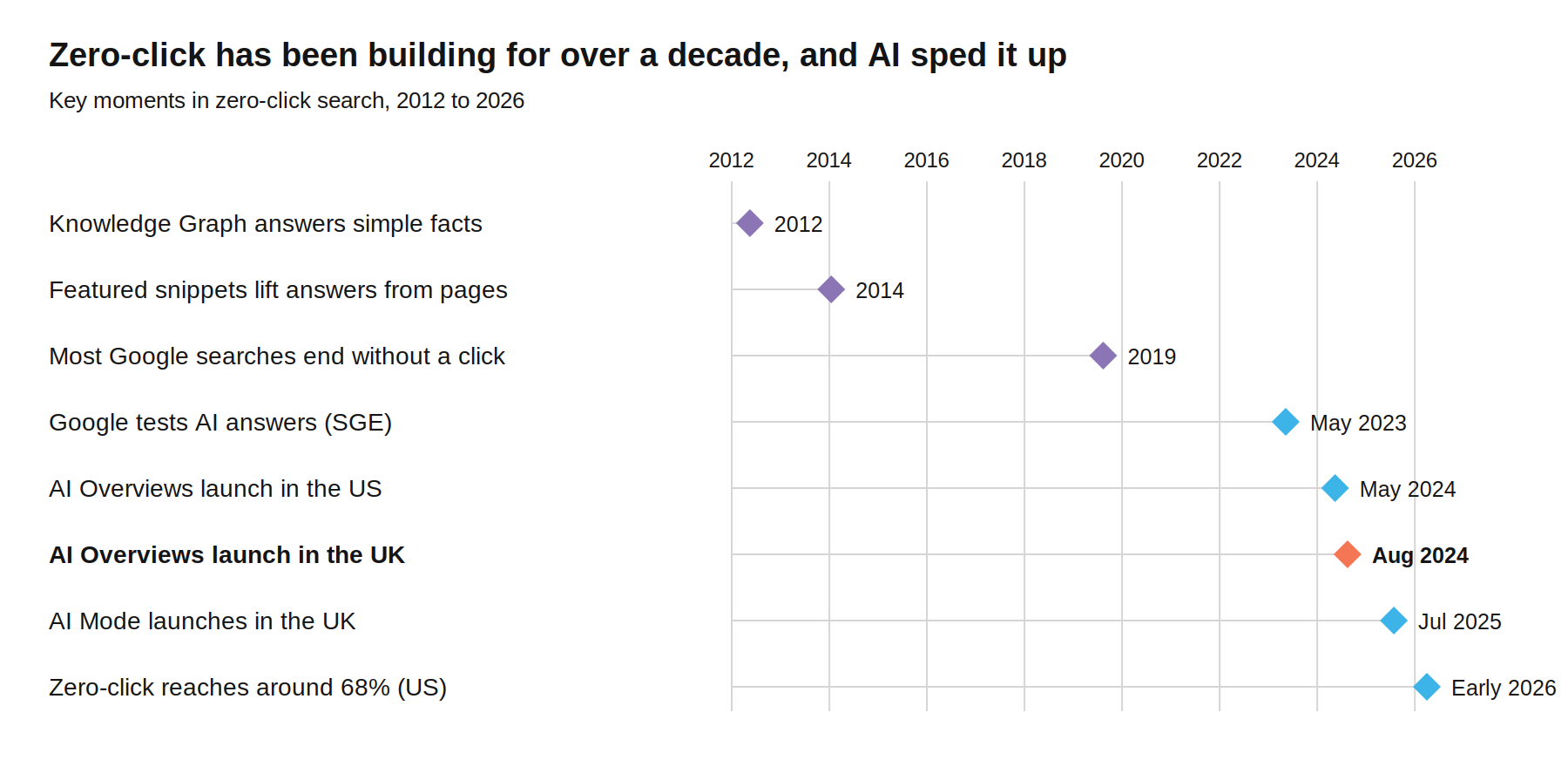
First came Knowledge Graph panels for simple facts, then featured snippets that lifted a paragraph straight from a web page. By 2019, SparkToro’s research showed that most Google searches already ended without a click.
So what’s different now? Two things.
Answers are written, not borrowed. A featured snippet showed one site’s words and credited it. An AI Overview writes its own summary from several sources, so the user rarely needs to visit any of them.
The scale is much bigger. Snippets appeared on a slice of searches. AI Overviews now appear across a large share of them, including longer and more detailed questions.
For UK sites, the key date is August 2024, when AI Overviews rolled out in the UK after launching in the US that May. AI Mode followed in July 2025, adding a full conversational search experience. If your informational traffic started to slip from late 2024, this is the most likely reason.
2.Where we are now
The latest numbers make the scale clear.
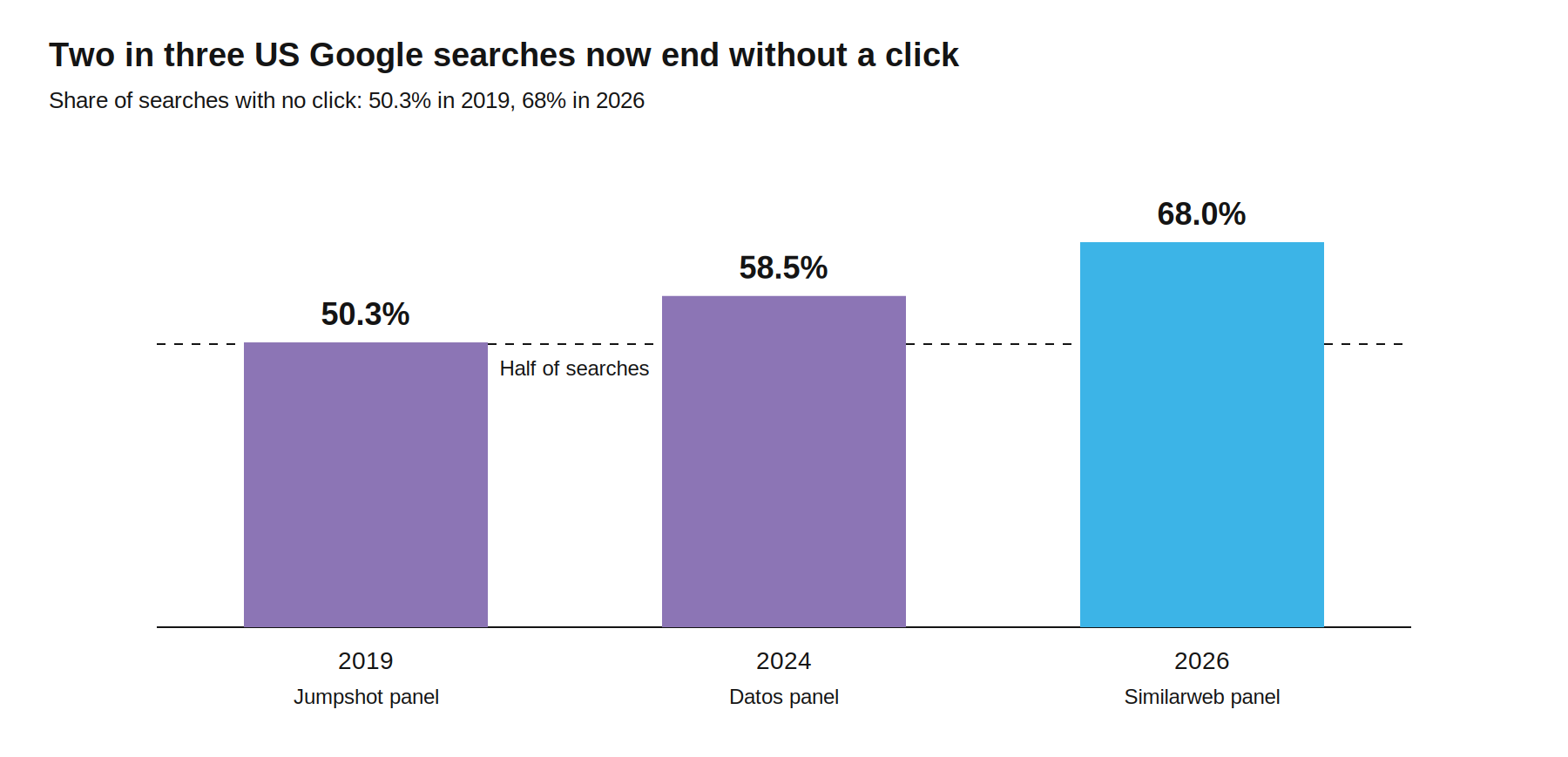
Around two thirds of searches end without a click. SparkToro’s 2026 study found around 68% of US Google searches produced no click at all, up from just under 60% two years earlier.
Mobile is higher still. Zero-click sits around half of searches on desktop and close to three quarters on mobile.
AI Overviews cut clicks to the top result. Ahrefs found that an AI Overview correlates with a 58% lower click-through rate for the page ranking first, nearly double the drop it measured in 2025.
Real users click less. Pew Research tracked real browsing and found people clicked a traditional result on 8% of searches with an AI summary, compared with 15% without one.
Two caveats. Almost all of this research is based on US searches, and different studies use different methods, so the exact figures vary. But every study points the same way: when an AI Overview appears, fewer people click.
3.Which searches are affected by 'zero-click'
The usual advice is that AI Overviews only hit informational searches, the “what is” and “how does” questions. Commercial searches, where people compare and choose, were thought to be safer.
In the UK, that’s no longer true. We tested 500 search terms in SEMrush across five industries (finance and insurance, property, travel, automotive, and home and trades), split evenly by what the searcher is trying to do. Of the 443 terms with results data, 72% showed an AI Overview.
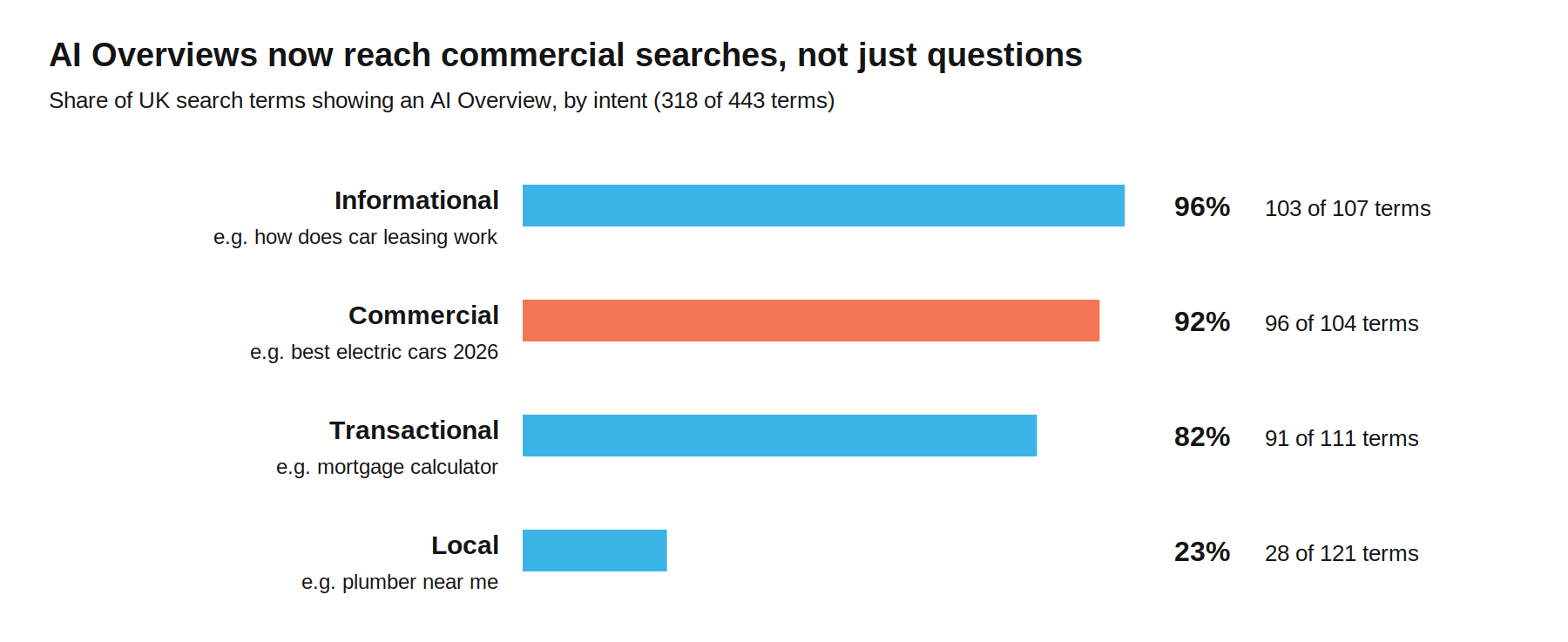
Informational: almost every question we checked showed an AI Overview, from “how does car leasing work” to “what is stamp duty”.
Commercial: more than nine in ten “best”, review and comparison searches showed one too. These are searches people make when they’re choosing a provider or a product.
Transactional: around four in five quote, calculator and deal searches showed one. Some booking-style searches still don’t.
Local: under a quarter of local searches showed one. The map still leads for “near me” searches, but AI Overviews are starting to appear here too, for searches such as “hotels near me” and “solicitors near me”.
The pattern holds in every industry we tested.
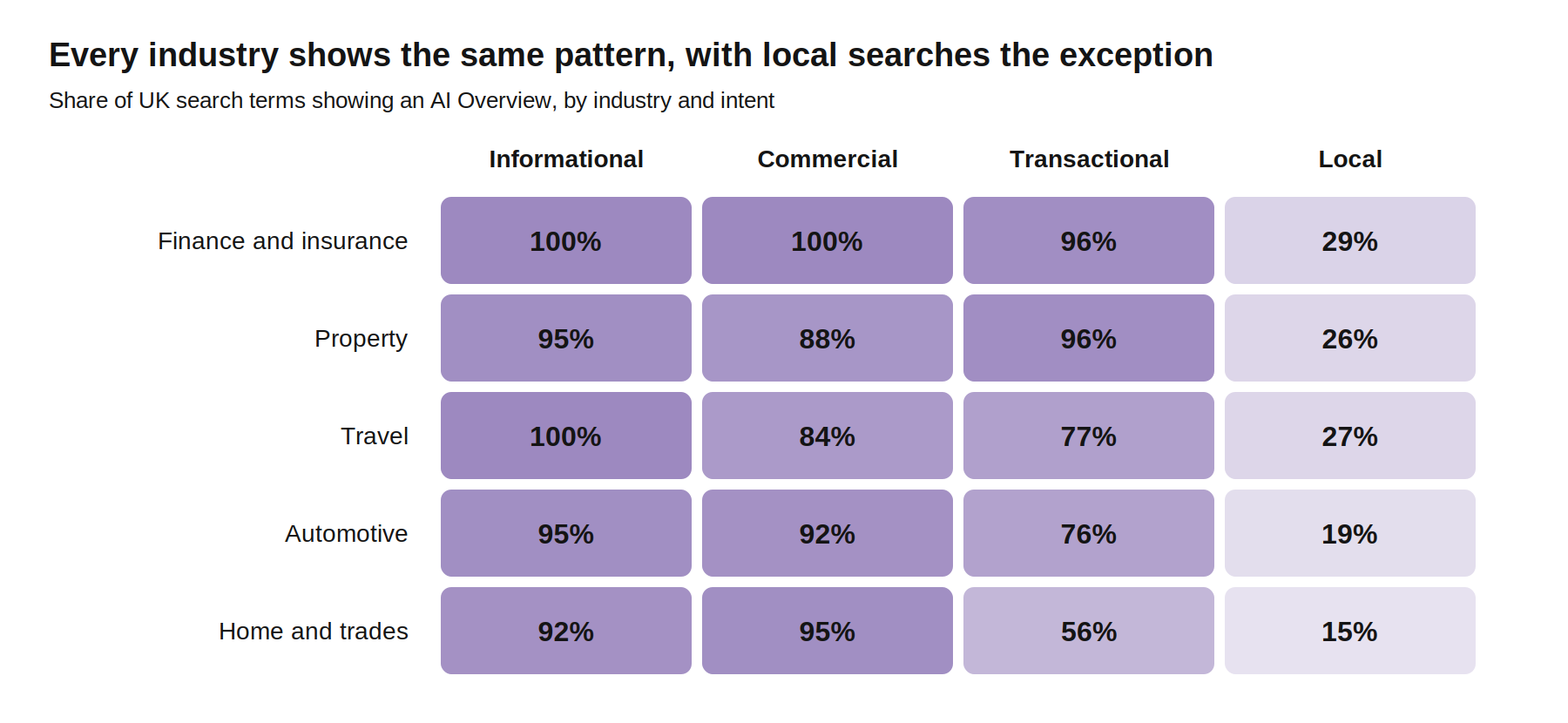
Finance and insurance stands out, with AI Overviews on nearly every informational, commercial and transactional search we checked. Home and trades has the lowest rate for transactional searches, because so many of them (“book a plumber”, “emergency plumber”) behave like local searches.
Compare this with Seer Interactive’s research, which found AI Overviews on 36% of informational queries but only 8% of commercial ones. Studies measure this differently, so the numbers aren’t directly comparable. But the direction is clear: AI Overviews have moved down the funnel, into the searches businesses care about most.
If most of your content targets informational or commercial searches, assume AI Overviews are already shaping how people see your brand.
4.What to expect going into 2027
The honest answer is that nobody knows exactly how search will look in a year’s time. But four signals are already clear, and they’re worth planning around.
Searches are getting longer and more conversational
AI Mode lets people ask detailed, multi-part questions and follow up on the answer. Google says early users asked questions two to three times longer than a typical search. The more a search feels like a conversation, the less reason there is to click away from it.
AI tools sit alongside Google, not instead of it
ChatGPT, Gemini and Perplexity are now part of how people research. But they haven’t replaced search. SparkToro and Datos found that while more than a fifth of Americans use AI tools regularly, almost everyone still uses traditional search every month. Your audience is using both, so your visibility needs to cover both.
Being remembered matters more than being clicked
When an AI Overview appears, people are less likely to remember where the information came from. In a Forbes Advisor experiment, source recall fell from 76% to 56% when an AI Overview was shown. Being cited isn’t enough on its own. Your brand needs to be the one people go looking for afterwards.
Measurement is catching up
Most reporting still counts clicks and sessions. Bain’s research estimates zero-click behaviour is reducing organic traffic by 15% to 25%, and recommends shifting from click-based metrics to search impressions and AI reach. Expect more businesses to report on AI visibility alongside traffic in 2027.
5.What we’re telling our clients
Zero-click search is happening, and we’re seeing it across our client base, not just in industry studies. So we’re giving every client the same advice.
Content success metrics have changed. If traffic is the only measure of whether a piece of content works, you’ll keep reporting a decline even when the content is doing its job. Visibility, AI citations and branded search need to sit alongside clicks.
Campaign metrics haven’t. At campaign level, the question is still the one that matters most: are we driving growth? For most businesses, that means revenue or leads. Fewer blog clicks is only a problem if it shows up there.
Review content in bulk, not page by page. Look across the whole library and ask of each piece: is this worth clicking on? Or is it falling because it answers a question an AI Overview now handles, so the click was never really needed?
Prove it beyond Search Console. Search Console shows the symptoms, but not whether an AI Overview appeared or whether you were cited. You need sight of what AI tools are actually showing before you change course.
Then ask whether the strategy needs to change. At Fresh Egg we start with the audience. If we’re now reaching that audience through an AI Overview rather than a blog read, we need to know, and we need to understand how that fits the wider plan. The audience hasn’t gone anywhere. The way they find us has shifted.
Fewer clicks on a blog post isn’t the problem. Reporting it as one is. If revenue and leads are growing, the job now is to show what that content is doing that a traffic graph can’t.
6.Content now has two jobs
This is the biggest change we’ve made to how we plan content. For years, most content had one job: rank, and get the click. Now there are two different jobs, and each piece of content should be clear about which one it’s doing.
 The problem for many sites is that a lot of their content does neither. It was written to rank for a quick question, so it’s exactly the kind of content an AI Overview now replaces. It doesn’t give people a reason to click, and it isn’t strong or distinctive enough to be the source AI tools choose to cite.
What this looks like in practice
We recently saw this pattern with one of our insurance clients. Clicks to their guides were down by around a quarter year on year, and two and a half times as many guides were declining as growing. On the surface, that looked like a content problem.
It wasn’t. The losses were concentrated in quick-answer guides: simple facts and general-interest questions that an AI Overview now answers in full. Guides on cost, risk and decisions told a different story. Their click-through rate was roughly double the quick-answer guides, and it held steady year on year. Where those guides had slipped, the issue was rankings, not clicks, and a content refresh would fix it.
Meanwhile, organic revenue was still growing year on year.
So we split the guides by job. Quick-answer guides now report on impressions and AI citations, with the aim of keeping the brand named as the expert source. Cost and decision guides are where we’re investing: more expert depth, more of the client’s own data, and clearer routes to the products people are researching.
7.Content that earns the click
Not every piece of content needs to earn a click. Informational, authority-building content still matters a great deal. Its job has simply changed.
When someone asks a quick question, the aim is for your brand to be part of the answer. If an AI Overview or ChatGPT draws on your content, your brand is in front of the user at the moment they’re learning about the topic. Over time, that’s how AI tools and people come to see you as the expert in your space.
That changes what success looks like for this content:
Being cited in AI Overviews and AI answers for the questions that matter in your market
Share of voice against competitors on those questions
Branded search growing over time, as people come looking for you by name
Topical authority: being the source AI tools return to across a whole subject, not just one page
Citations bring traffic benefits too. Seer Interactive found that brands cited in an AI Overview earned substantially more organic clicks per impression than when they weren’t cited.
What makes content citable? Clear, direct answers near the top of the page, real expertise, and a consistent presence across the web, from your own site to reviews, PR coverage and the communities where your audience talks.
8.A new approach for your existing content
You don’t need to start from scratch. Most sites already have plenty of content. The work is deciding what each piece is for.
 Fresh Egg framework: sorting existing content by job.
Start with the pages that have lost the most clicks, then work through them one at a time:
Does it help people do or decide something? If it can, make that its job. Strengthen it with the things a summary can’t offer: your own data, a tool, pricing or a proper comparison.
If not, does it answer a question your audience genuinely asks? Then its job is to earn the citation. Lead with a clear, direct answer, show real expertise, and measure it on visibility rather than clicks.
If it does neither, merge it into a stronger page or retire it. Thin pages written for a quick answer dilute the rest of your site.
Then plan new content the same way. Before anything is written, agree which job it’s doing and how you’ll measure it. That one decision changes the brief, the format and what you report on.
9.What next
Zero-click search isn’t going away, and going into 2027 it’s reaching further into the searches that drive business. But fewer clicks doesn’t have to mean less value. The brands that do well will be the ones that know what each piece of content is for: earning the click when people need to go deeper, and earning the citation when they just need an answer.
Ready for zero-click search?
We’ll show you which content still earns the click, where AI is answering for you, and how to measure success in 2027.