
How a Test Repository Drives a 40% CRO Win Rate

By Tim Richards|3 Mar 2026
Our CRO team has spent years nurturing a culture of testing and curiosity. During that time, our test repository has grown to include hundreds of experiments across multiple sectors. The result? A unique view of what really moves the needle on conversion. While research suggests the average win rate for testing programmes is 12%-20% (Optimizely), our programmes consistently deliver a 40% win rate.
Watch the full 1-hour event: How we achieve 40% win-rates in CRO testing
In this recorded session, we break down the exact testing framework behind our 40% win rate, including how we structure hypotheses, prioritise experiments, and build a reusable test repository across industries.
Why our testing programmes outperform the industry
Our win rate isn't just the result of disciplined, hypothesis-driven testing. It's the combination of that rigour and a rich test repository, built from hundreds of experiments, that powers consistent success across industries.
To help you see what powers our multi-award-winning performance work, I'll unpack what a test repository is and the five common conversion drivers we've uncovered across key industries, including:
- Charity
- Financial services
- Real Estate
- Retail
These insights have been instrumental in driving our multimillion-pound wins.
Firstly, what is a test repository?
A test repository is your CRO team's database (for Harry Potter fans, it's the 'Pensieve'), which contains information about all the experiments you have tested.
Instead of results buried in a file for no one else to see, all experiments are stored in one place.
A test repository is about making test results viewable across your team and organisation, facilitating better decision-making and driving a more integrated culture of experimentation.
Why a test repository is an essential element of your optimisation success
A test repository is a vital part of your CRO toolkit for driving your testing maturity. Here at Fresh Egg, through years of using a testing repository at the heart of our testing programmes, below are some reasons why it is an important addition:
- Centralised source of truth: Being able to keep all your hypotheses, results and insights all in one searchable location is a game-changer. Not only does this make test outcomes searchable as a trusted source of truth, but it also enables stakeholders from other teams to view what has been tested previously.
- Discover new patterns and themes: A test repository allows your team to not only store top-level test information, but it also provides an opportunity to enrich your test insight even further through categorisation of experiments. For example, enriching through test difficulty allows your team to understand whether larger experiments drive higher uplifts.
- Improves experimentation culture and adoption: Centralising experiment data fosters a stronger experimentation culture. Insights become accessible, stakeholders feel more confident accessing and viewing experiments, all helping to drive curiosity about experimentation.
- Speeds up decision-making: A test repository helps your team understand what is working and what does not resonate with your customers. The resource helps teams improve decision-making about which test types to run, positively impacting testing velocity and win rate.
What we have learnt from hundreds of tests across numerous industries
By logging every hypothesis, outcome, and uplift in our test repository, we can understand recurring behaviours, universal conversion drivers, and sector-specific trends that would be impossible to uncover without the resource.
Driving impact through the UX dimension framework
By enriching our test repository with our UX dimension framework, we have identified five trends that could help drive the impact of your experimentation.
1. Motivation and clarity: a key driver for insurance & financial services
For products like insurance and financial services, the user journey can feel daunting and confusing, especially with acronyms like IPT, IPID, and others.
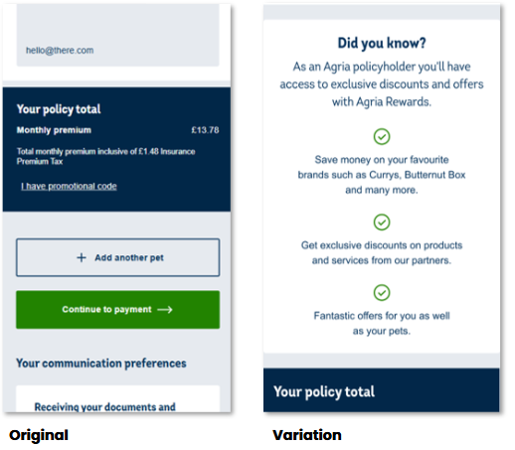
Our extensive expertise in both areas shows that surfacing clear, motivating content is vital. Tests focused on motivation and clarity have driven our highest win rate of 40% across clients in this sector.
Case study: Agria Pet Insurance
One example (shown below): motivational reward copy in the Agria Pet Insurance journey drove a +5.6% increase in policy sales.
2. Motivational cues drive the highest win rate for Charity websites
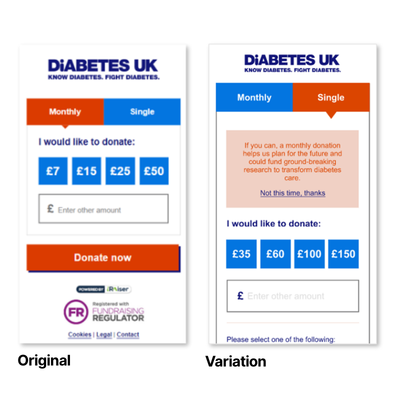
Our expertise in testing across multiple charity clients clearly shows that experiments focusing on motivation and emotional cues are the most successful, with 1 in 2 tests showing a statistically significant positive uplift.
Case Study: Diabetes UK
This pattern is evident in a test designed to drive donations and regular giving. By surfacing motivational content highlighting the specific benefits of regular giving, Diabetes UK saw a 25% increase in monthly giving.
Our results speak volumes
![]()
+£3.2 million revenue for Sharps by adding local Social Proof
We helped Sharps unlock £3.2M in projected annual revenue by adding localised Social Proof to their booking journey, boosting design visit conversions by 2.5%.
![]()
£408K boost for LeaseCar with SEO & CRO
We helped LeaseCar.uk boost revenue by £408K in 8 months with a full-funnel SEO and CRO strategy, beating targets by 118%.
![]()
29% sales increase for Agria
Through our transformation of the Agria Pet Insurance web estate with an Umbraco web build, we impacted a 29% increase in sales.
![]()
$2.5m uplift for Aardy.com
Through our 'Performance Guarantee' offering, we helped drive a huge +$2.5m annual incremental revenue for Aardy in one test, exceeding the target by +173%.
![]()
£2.6m uplift for Ageas
We helped Ageas drive +£2.6m annual incremental revenue through a single A/B experiment.


3. Improve online checkouts through trust and social signals
Regardless of the sector, payment and checkout pages are often sources of friction. Findings from our repository detail that trust indicators and social proof consistently boost conversion at this critical stage.
Making trust tangible is critical. In several experiments, we added trust badges (e.g., SSL icons, payment provider logos) and concise reassurance copy. We have seen a leading financial client boost checkout-to-sale conversion by +12% by adding clear trust signals—secure payment badges and reassuring copy that highlighted (and amplified) TLS protection.
Leveraging social proof
Displaying customer ratings or testimonials near payment CTAs is also beneficial. On one retail checkout page, adding a small "Rated 4.9/5 by 3,000+ customers" line next to the "Complete Purchase" button increased the completion rate by +11%.
The takeaway? Across checkout pages, our testing win rate is 57%. Social proof and trust have been at the heart of this above-average win rate.
So remember, when users reach the final step, trust and social validation can tip the balance in your favour.
4. Drive sales through content clarity and reassurance
Ecommerce shoppers are spoiled for choice, so the clarity of your content can be the difference between a sale and an abandoned cart, especially in highly competitive products. We have seen a clear trend toward greater clarity in benefits and content, driving increased sales.
For a well-known retail client, we drove a +4.6% increase in conversion to enquiry by providing clear content highlighting benefits to reassure.
Reducing Friction on Category Pages
Other successful experiments in our repository focused on optimising the user interface to help customers find relevant items faster. Key adjustments included:
- Above-the-fold filters: Moving filtering options to the top of the page for immediate accessibility.
- Streamlined layouts: Reducing the number of products per page to prevent choice paralysis.
- Quickview buttons: Allowing users to preview details without leaving the category results.
In all these tests, the underlying principle was the same: reduce friction through clear content and reassurance.
5. Clear decision-making and personalised content drive strong uplift for Real Estate
Real estate sites often serve both buyers and sellers, often resulting in long, information-heavy pages. Our repository shows that simple UX changes in high-friction areas can make a real difference, with this UX dimension driving a 44% win rate in the real estate industry.
Sticky Call to Action (CTA)
Despite being a simple UX change, we have seen sticky CTAs have a significant impact. Keeping these buttons visible as users scrolled eliminated the need to hunt for the next step, a common source of friction on long property pages.
The Result: This simple UX change increased viewing requests by 28% in one test.
Personalisation
When analysing our test repository by test location, it was clear that personalisation is king for property pages. With such a vast amount of properties and content, users demand a more tailored experience.
- Geo-location targeting: Changing property landing pages based on a user's location has increased conversions by up to 9.5%.
Whether it is a simple button placement or complex data-driven personalisation, reducing the cognitive load for property seekers is key to conversion.
Conclusion
In short, our 40% win rate isn't down to luck. It's the product of a disciplined testing culture powered by a living, breathing test repository, enriched with other data sources.
By pooling insights from hundreds of experiments across sectors, this article has uncovered only a small fraction of the insights available at an industry-specific level.
These top-level insights show that a repository isn’t merely an archive; it’s the driving force to conversion success for your optimisation programme.
Turn your website into a conversion engine
If you're investing in traffic but not seeing the returns you expect, the problem isn't always acquisition; it's what happens after the click. We help ambitious organisations unlock measurable growth through integrated optimisation, combining CRO, SEO, data, and web expertise into a single outcome-focused intelligent experience. We will help you increase your conversion rate.
Get Fresh Thinking and Stay Ahead of Digital Marketing Trends
Subscribe to our Fresh Thinking Newsletter and get...
✅ Exclusive invites to our helpful knowledge-share events✅ Curated news roundup of pertinent and topical industry news
✅ Early access to our industry resources and insights.
Register for Fresh Thinking and keep up to date with our helpful digital marketing news insights.